Xylophone
Turn around, turn around, there's a thing there that can be found ♪(๑ᴖ◡ᴖ๑)♪
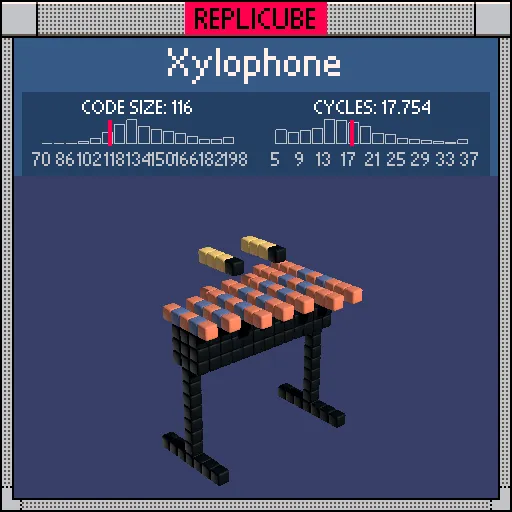
| Grid | Code Size | Leaderboard | Cycles | Leaderboard | Date |
|---|---|---|---|---|---|
| 17x17x17 | 116 | #109 | 17.754 | #494 | 2026-02-24 |
Solution
a=abs(x)
b=abs(z)
if y==3 and a<8 and x%2<1 and b<(x+9)//6+3 then
return b~=1 and 8 or 2
end
if y>-1 and y<3 and a<7 and b<2 then return 3 end
if a==6 and y<0 and(z==0 or y==-8 and b<4)then return 3 end
if a==2 and y==6 and z>-4 and z<1 then return z~=0 and 9 or 3 end
How it works
Four pieces: the bars, the frame, the legs, and the mallets.
The bars sit at y=3 across every even x position. Each bar gets wider as x increases, controlled by (x+9)//6+3 which steps the half-width from 3 up to 5 in groups of three. This gives the classic xylophone taper from short high notes to long low notes. The edge voxels (abs(z)==1) are painted GREY for a metallic rim, with ORANGE fill everywhere else.
The frame is a BLACK rail running along both sides at abs(x)<7, sitting just below the bars at y=0 through y=2, only one voxel wide in z.
The legs drop straight down from x=+-6, a single BLACK post at z=0 all the way to the bottom, where they spread into a flat BLACK foot at y=-8.
The mallets are two little sticks at x=+-2, y=6, extending back in z. The tip at z=0 is BLACK for the handle, and the head behind it is YELLOW.