Billiards Table
Legs, frame, pockets, and green felt all in one chain ᕙ(⇀‸↼‶)ᕗ
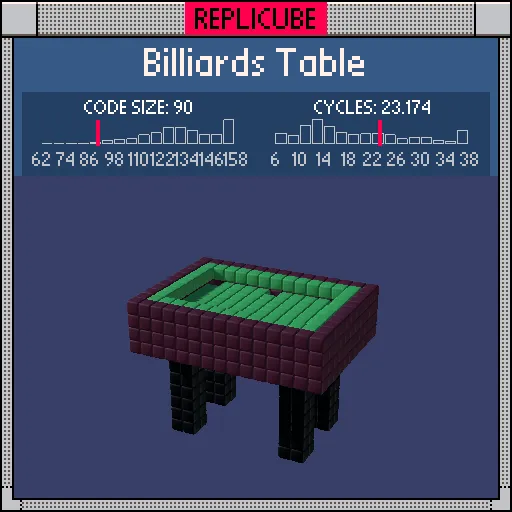
| Grid | Code Size | Leaderboard | Cycles | Leaderboard | Date |
|---|---|---|---|---|---|
| 15x15x15 | 90 | #22 | 23.174 | #922 | 2026-02-24 |
Solution
a=abs(x)b=abs(z)m=max(a,b-2)
return y<0 and a&-2==2 and b&-2==4 and 3 or y>-1 and m<6 and(y<2 and 16 or y<4 and(y==3 and m==4 and 11 or m>3 and 16 or y==2 and(a~=3 or b%5>0)and 11))
How it works
The key variable is m=max(abs(x), abs(z)-2). The table is longer in z than x, so subtracting 2 from abs(z) makes it a nice centered Chebyshev distance. Everything layers on top of that.
The legs (BLACK) sit under the table at four corners. a&-2==2 is a bit trick that matches abs(x)=2 or 3, and b&-2==4 matches abs(z)=4 or 5. Two checks, four legs.
The table body (DARKBROWN) at y=0,1 is just y<2 and 16 for anything inside m<6.
At y=2 and y=3, the rim (DARKBROWN) wraps around the outer edge where m>3, and the green felt fills the inside. The felt surface at y=2 has six pocket holes carved out with a~=3 or b%5>0, which removes voxels at the corners and midpoints. At y=3, the GREEN rail sits at m==4 with open air above the table inside.